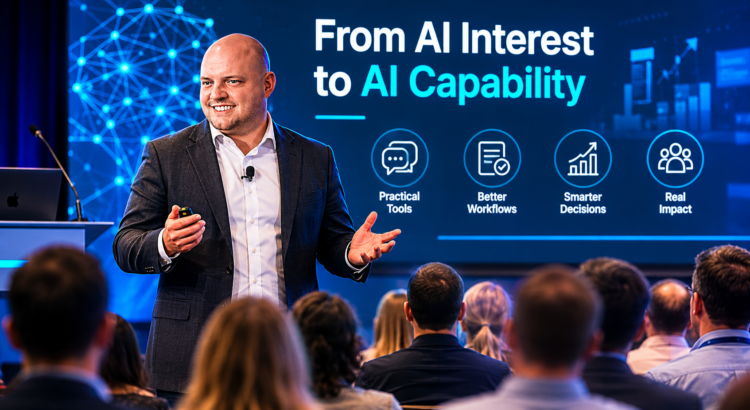
I wrote this at the end of a week that I will remember for a while. Not because anything dramatic happened, but because the numbers quietly tell a story I’ve been watching for months. In a series of AI enablement sessions, I spoke to more than 3,000 people this week. One session alone was attended by 1,700 participants, which is a record for me for the number of spectators.
I’m not sharing those numbers to impress anyone. I shared it because of the signal. When one session pulled 1,700 working professionals out of their inboxes for an hour at a massive billion-dollar company, the question of whether organizations were interested in AI was answered. The interest is there. What society lacks is a practical path from interest to ability.
What exactly is involved in this week
It was a really mixed week. My flagship Art of the Possible session runs alongside several Microsoft-focused sessions covering M365 Copilot, Excel with Copilot Chat, and broader AI transformation topics. Different audiences, different levels of belief, but a consistent storyline running through them all.
Art of the Possible is intentionally not a feature tour. These are the sessions I run when people need to see, in their own work context, what’s possible when AI sits within the tools they already use. Microsoft Sessions then took that and made it happen. Copilot in the workflow. Copilot Chat performs the analysis that people usually dread in Excel. The switch from “this looks clever” to “I can finish my Tuesday with this” tends to happen in the middle of the session, and you can usually feel the room changing when that happens.
Where the organization is actually located
If you only read the headlines, you would assume that most organizations have either completely changed or are far behind. The reality I saw this week was more ordinary and more encouraging.
Most people are not resistant. They weren’t sure. They’ve heard the claims, probably had a license issued to them, and tried it a time or two with mixed results. They are not skeptical of AI itself. They are skeptical of the gap between the demo and their actual work. Skepticism is healthy, and I don’t want to talk about this to anyone.
The second thing I noticed was that the questions were mature. A year ago, the questions were “what is this” and “is it safe”. This week the questions are sharper. How to get reliable results rather than lucky results. How do I write a prompt that works the same way twice? How do I bring this into the processes my team already follows? They are questions from people who have moved beyond curiosity and desire competence.
The third observation is the most important for anyone planning a launch. Access is not adoption. Giving someone a Copilot license and assuming usage will follow is like giving someone a gym membership and assuming fitness will follow. Licensing is a start. These abilities are built intentionally, with structure, and usually with someone showing the way.
The framework underneath
The big difference between lucky results and reliable results is in the way people give advice. All week I leaned on a simple structure, the CHAPTER approach, which gives people a repeatable way to structure requests rather than hoping the model guesses their intent. It’s not the only framework I use, but it is the one that works best in mixed-ability spaces. People remember it, they use it the next morning, and that’s the test that matters.
The reason the structure works is because it turns AI from a novelty into a habit. Habit scale. Novelty no. An organization that gives its people some reliable patterns will see more change in a single quarter than an organization that runs one launch event and inspires hope.
That is if you are planning a launch
If you are an L&D leader or decision maker considering how to apply Copilot and AI capabilities across your workforce, the desires I described above are on your side. Your people want this. The effort needs to be made to provide them with a path that respects their time and skepticism, and builds true capability, not awareness.
That’s what my AI Empowerment Program was created for, and Art of the Possible is usually where it starts. This session creates an appetite. The program turns it into something that lasts after the room vacates.
If any of this fits your organization, I’d be happy to talk about it. Not a pitch, just a conversation about what a launch would look like if it was based on how real people work. You can find me at gethynellis.com, and the quickest way to get started is to tell me where your organization is today and where you want to be by the end of this year.
Useful Links
Stop Typing Garbage into AI — There’s a Better Way
Why I Built LastPersonStanding.net (And Why I Couldn’t Abandon the Idea)
From Data to Insight: Why Meaning Must Be Made Explicit
PakarPBN
A Private Blog Network (PBN) is a collection of websites that are controlled by a single individual or organization and used primarily to build backlinks to a “money site” in order to influence its ranking in search engines such as Google. The core idea behind a PBN is based on the importance of backlinks in Google’s ranking algorithm. Since Google views backlinks as signals of authority and trust, some website owners attempt to artificially create these signals through a controlled network of sites.
In a typical PBN setup, the owner acquires expired or aged domains that already have existing authority, backlinks, and history. These domains are rebuilt with new content and hosted separately, often using different IP addresses, hosting providers, themes, and ownership details to make them appear unrelated. Within the content published on these sites, links are strategically placed that point to the main website the owner wants to rank higher. By doing this, the owner attempts to pass link equity (also known as “link juice”) from the PBN sites to the target website.
The purpose of a PBN is to give the impression that the target website is naturally earning links from multiple independent sources. If done effectively, this can temporarily improve keyword rankings, increase organic visibility, and drive more traffic from search results.