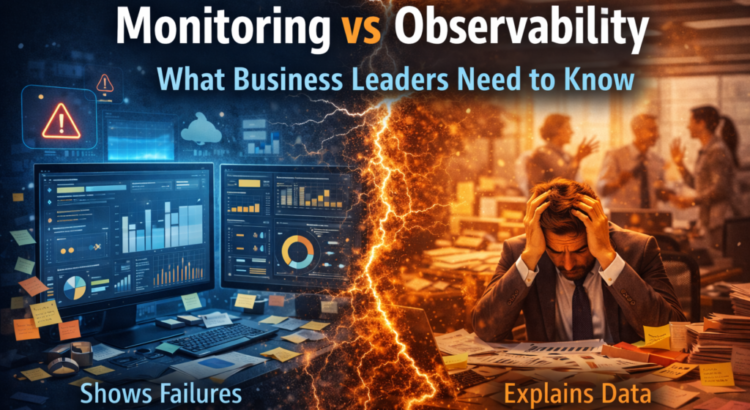
Monitoring vs Observability: What Business Leaders Need to Know
As an organization grows, common frustrations emerge.
- The dashboard is there.
- Monitoring has been carried out.
- Fire warning.
But leaders still ask:
“Why don’t we see this happening?”
This is where the conversation often leads observation ability. This is a technical sounding term, but the problem is not.
Monitoring feels reassuring – until it isn’t
Most organizations already monitor their systems and reporting.
They track:
- System uptime
- Refresh failure
- Data latency
- Pipeline errors
From a distance everything looks under control.
Until:
- The board pack is challenged
- A number of sudden changes
- Critical metrics drift for no apparent reason
At that point, monitoring notifies you There is something wrong, but not Why.
Monitoring answers “Is something broken?”
Monitoring is about known failure state.
This works well when:
- You know what “good” looks like
- You know what can break
- You know the thresholds to be aware of
Example:
- Was the report refresh successful?
- Has the pipeline failed?
- Is the system up or down?
Monitoring is important, but it is designed to be reactive. This tells you after something crossed the line.
Observability answers “Why did this happen?”
Observability starts from a different place.
This assumes:
- The most important problems are not always predictable
- Business questions change faster than systems
- Failure is often subtle before it is obvious
Observability is about understand behaviornot only detect failures.
For leaders, that means being able to answer:
- Why did this metric change?
- Where does the data come from?
- What else is affected?
- Can we believe this insight today?
This is not a debate about tools
Monitoring vs observability is often framed as a technical improvement.
- New tool.
- New dashboard.
- New telemetry.
That’s not on point.
Observability is not something you have install. It’s something you design for. Without clarity, observability tools will only produce more noise.
Why leaders feel the pain first
As the organization scales:
- Data flow increases
- Dependencies multiply
- Decision-making cycles become shorter
The leader feels the consequences before the team feels the cause.
General symptoms:
- Meetings are spent debating numbers rather than decisions
- Insights that come too late are a problem
- Increased reliance on manual explanations
- “Can someone check his sanity?”
At this stage, the organization does not lack supervision. That’s a lack of understanding.
The hidden disadvantage of poor observation skills
When observability is weak:
- Self-confidence decreases
- The speed of decision making slows down
- Risks increase silently
Leaders start:
- Request more reports
- Ask for more details
- Commission parallel analysis
Ironically, this actually makes the problem worse. More reporting ≠ more insight.
What observation really means for leaders
For business leaders, observability is the ability to:
- Trace the number back to its source
- Understand how metrics are created
- See when assumptions change
- Spot drift before it becomes a failure
Here’s the difference between:
“The number is wrong”
And
“We know exactly why it changed, and what to do next.”
Why don’t platforms automatically give you observability
Modern platforms make observation possible Possible.
They didn’t succeed can’t be avoided.
Without:
- Remove metric ownership
- Agreed definition
- Decision-focused design
- Aligned leadership expectations
Observation tools can uncover existing confusion more quickly. This is why organizations often invest large amounts, but still feel blindsided.
Monitoring tells you when to panic. Observability tells you when to act
Monitoring is about protection.
Observability is about self-confidence.
Both are important, but solve different problems.
Leaders don’t need more warning.
They need fewer surprises.
Why this matters now
As an organization grows, complexity increases faster than understanding.
Here’s why:
- Reporting slows down
- Insights feel harder to extract
- Trust is eroding silently
The problem isn’t that the team isn’t working hard. This is because the organization has moved beyond its original approach to insight.
This is suitable for a series
This article follows:
And leading to the next question leaders often ask:
That’s where we’ll go next.
These are also the challenges faced by organizations Data & Analytics Accelerator usually framed as a tooling problem, but rooted in clarity, ownership, and design.
Better leadership questions
Instead of asking:
“Do we need better monitoring?”
A more useful question would be:
“Do we understand what our data is telling us, and why?”
When leaders can answer them with confidence, the technology finally starts to work For business, not against it.
Useful Links
How to Achieve Key Business Goals with Data-Driven Strategy and AI Tools
What If Rejection Was the First Step to Success?
Lessons from the Fantasy Premier League: Data, Decisions, and Power BI
News
Berita Teknologi
Berita Olahraga
Sports news
sports
Motivation
football prediction
technology
Berita Technologi
Berita Terkini
Tempat Wisata
News Flash
Football
Gaming
Game News
Gamers
Jasa Artikel
Jasa Backlink
Agen234
Agen234
Agen234
Resep
Download Film
Gaming center adalah sebuah tempat atau fasilitas yang menyediakan berbagai perangkat dan layanan untuk bermain video game, baik di PC, konsol, maupun mesin arcade. Gaming center ini bisa dikunjungi oleh siapa saja yang ingin bermain game secara individu atau bersama teman-teman. Beberapa gaming center juga sering digunakan sebagai lokasi turnamen game atau esports.