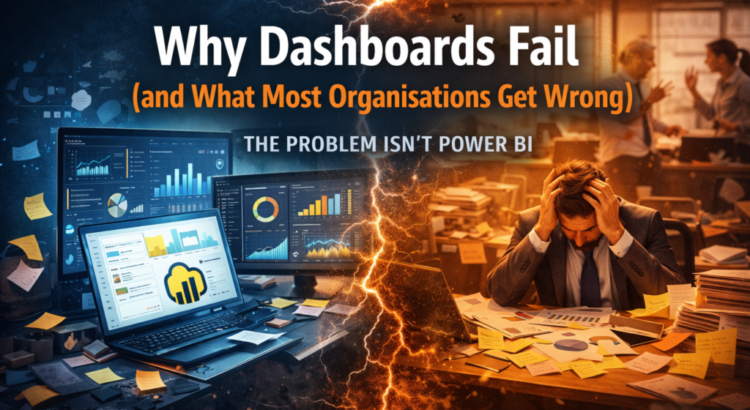
Why Dashboards Fail (and What Most Organizations Do Wrong). For many organizations, dashboards start with optimism and end in frustration.
Power BI looks promising. Report generated. The stakeholders are very excited. And then, slowly but surely, confidence erodes.
- People stopped believing the numbers.
- Reports are increasing.
- The decision comes down to instinct.
The problem is not with the dashboard tool. This is something much more basic.
A quick note on dashboards vs reports in Power BI
In Power BI, dashboard And report are technically different things.
- Report is a multi-page, interactive, and analytical asset. They are built from a single semantic model and are used to explore, share, and search data. This is where most of the analysis and questioning occurs.
- Dashboardinstead, it is a high-level one-page summary. They consist of embedded visuals from one or more reports and are designed for monitoring, awareness, and glances, often for senior stakeholders.
However, in practice, many organizations use the term “dashboard” as an abbreviation for all business reporting and analysis, including reports, scorecards, and executive views. That is the meaning of the terms used in this article.
The failure patterns described here also apply to dashboards And report: lack of shared definition, unclear ownership, decision-free design, and cultural assumptions.
Dashboards don’t fail because of technology
Most organizations consider dashboards a failure because:
- The data model is not quite right
- The visuals could be better
- Performance needs adjustment
- Or they need it Next platform upgrade
In reality, dashboards fail because they are built before clarity exists. The dashboard is output. Yet many organizations treat them as starting point.
The real reason why dashboards fail
In my opinion, the real reason why dashboards fail is because
1. There is no common definition of “truth”
Ask five people from the same organization what key metrics mean, and you’ll often get five answers. You need a clear definition of
- Income
- Active customers
- Conversion
- Engagement
If the definition is not agreed upon beforehand, the dashboard will become a political tool and not a decision-making tool.
Without a shared definition, the result is:
- Endless debate
- Manual “sense check”
- Offline spreadsheets to “validate” reports
At that point, the dashboard was dead.
2. Dashboards are built on data, not decisions
Common questions during project reporting are:
“What data do we have?”
A better question would be:
“What decision do we want to make?”
When dashboards are designed based on available data, not based on business decisions:
- They get messy
- Stakeholders don’t know where to focus
- Important signals are buried in noise
A nice dashboard doesn’t appear everything.
They show what’s important now.
3. Ownership is unclear
This is often a big problem. Who owns the dashboard?
- HE?
- Data?
- Finance?
- The business?
If ownership is not explicit:
- Requests pile up
- Changes occur on an ad hoc basis
- No one is responsible for their quality or relevance
Dashboards are broken not because people don’t care, but because responsibilities are fragmented. I have read this many times in management and leadership books
If three people were responsible for feeding the dog, the dog would starve.
4. Reporting scales faster than understanding
As the organization grows:
- More systems emerged
- More metrics to track
- More and more stakeholders want a personalized view
The complexity of reporting increases exponentially, while understanding does not.
This is why reporting often slows down right when businesses need speed most.
Dashboards built for small teams rarely survive organizational growth without rethinking structure, governance, and intent.
5. Culture is assumed, not designed
This is where modern platforms, such as Microsoft Fabric, are often misunderstood by business decision makers.
Fabric can unite data.
It can center the tooling.
This can simplify the architecture.
But it can’t:
- Align leadership expectations
- Determine decision-making rights
- Create trust in metrics
- Build accountability
If data culture is broken, no platform can fix it.
Dashboards fail when clarity comes last
Across all organization sizes, the pattern is consistent:
- Tools implemented
- Dashboard created
- Questions arise
- Trust decreases
- The momentum stalled
The missing step is clarity before construction.
Ambient clarity:
- What decisions matter
- Which metrics drive those decisions
- Who owns it
- How they are interpreted and challenged
Without it, the dashboard becomes expensive wallpaper.
What successful organizations do differently
In my experience, organizations that gain long-term benefits from dashboards take a different approach:
- They start with decision making, not visualization
- They align leaders before reporting
- They treat dashboards as evolving products, not one-off results
- They improve structure and ownership before scaling equipment
The dashboard then becomes an accelerator, not an obstacle.
Why this is important
If your organization:
- Have lots of dashboards but lack confidence
- Was “looking at Fabric” but not sure where to start
- It feels like reporting should provide more value at this point
Then the problem may not be a technical one.
This is strategic.
And until these issues are resolved, dashboards will continue to disappoint—no matter how modern the platform is.
Where this fits into the bigger picture
This is the first in a series of short explorations why data initiatives stall as organizations growincluding:
These are the problems we see organizations bringing into our lives Data & Analytics Accelerator, long before they ask about dashboards or tools.
The next step
If this resonates with you, the next question to ask is not:
“Which dashboard should we create next?”
He:
“Do we really have clarity on what we want to achieve?”
That’s where progress begins.
News
Berita Teknologi
Berita Olahraga
Sports news
sports
Motivation
football prediction
technology
Berita Technologi
Berita Terkini
Tempat Wisata
News Flash
Football
Gaming
Game News
Gamers
Jasa Artikel
Jasa Backlink
Agen234
Agen234
Agen234
Resep
Download Film
Gaming center adalah sebuah tempat atau fasilitas yang menyediakan berbagai perangkat dan layanan untuk bermain video game, baik di PC, konsol, maupun mesin arcade. Gaming center ini bisa dikunjungi oleh siapa saja yang ingin bermain game secara individu atau bersama teman-teman. Beberapa gaming center juga sering digunakan sebagai lokasi turnamen game atau esports.