- A new platform.
- A more integrated stack.
- A promise that this time things would be different.
This is where platforms like Microsoft Fabric come into play.
- The fabric is strong.
- Modern.
- Well architected.
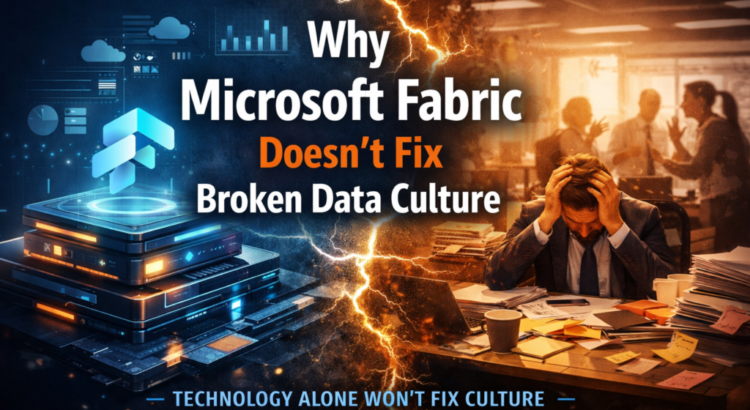
But it is also one of the most misunderstood investment organizations. Because the platform doesn’t let the organization down. Organizations fail to change the way they work around it.
Platform myths
There are comforting beliefs like this:
“When we are on the right platform, everything will go according to plan.”
- Data will be trusted
- Reporting will be faster
- Teams will align
- Decisions will improve
This platform is a representation of leadership, strategy and culture. That belief is understandable, but it is wrong.
What platforms are actually good?
Let’s be clear: platforms like Microsoft Fabric are not the problem.
They are very good at:
- Data centralization
- Standardization of tools
- Reduces architectural sprawl
- Enables scale and performance
- Supports modern analytical patterns
Fabric can eliminate technical friction. What cannot be eliminated is organizational friction.
A broken data culture looks like this.
Before blaming tools, it’s worth recognizing the symptoms of a broken data culture:
- Metrics are more debated than decisions
- Reports exist, but confidence is low
- Teams optimize locally, not collectively
- Data ownership is unclear or political
- Leadership demands insight, but values speed over precision
In this environment, new platforms do not create clarity; it amplifies the confusion.
Why platforms don’t fix culture
Here are some reasons that explain why data platforms do not improve an organization’s data and culture
1. Platforms do not define goals
Data platforms can answer:
“Where is the data located?”
It can’t answer:
“Why is this data important?”
Without a shared understanding of:
- Business priorities
- Important decision
- Measure of success
Even the best platforms become expensive filing cabinets.
2. The platform is not aligned with leadership
Data culture is established at the top of a business or organization.
If the leader:
- Ask for different numbers in different meetings
- Replace data with instinct if it’s not comfortable
- Awarding rather than quality
Then no platform will create trust. Culture is reinforced by behavior, not architecture.
3. The platform does not solve the ownership problem
Modern platforms centralize data, but they don’t magically provide accountability.
Without clear ownership:
- Data quality issues still exist
- Definition of drift
- “Someone else has it” becomes the default
Fabric can host your data estate. It can’t tell you who is responsible for it.
4. The platform does not simplify decision making
A common failure mode is more capability, less clarity.
With a powerful platform:
- More data can be accessed
- More metrics are emerging
- More dashboards created
However, without discipline in decision making, this will lead to:
- Cognitive overload
- Meetings are slower
- Analysis paralysis
Better tools don’t automatically mean better decisions.
5. Platforms do not change incentives
People respond to what they measure. If teams are incentivized to:
- Delivers quickly, not accurately
- Protect their numbers rather than challenge them
- Avoid uncomfortable insights
Then the culture will not change, whatever the platform.
Technology follows incentives, not the other way around.
When the platform works
Organizations that are successful with platforms like Microsoft Fabric tend to do several things differently:
- They establish clarity before migration
- They define decision ownership early on
- They align leaders on what is “good.”
- They treat the platform as a supporting factor, not a savior
In an environment like this, Fabric accelerates progress rather than opening gaps.
The unpleasant truth
If the dashboard is already problematic…
If trust in data is fragile…
If reporting feels slower every year…
A new platform won’t solve those problems. This will bring it up faster.
Why this is important
Many organizations invest heavily in platforms expecting transformation. What they actually get is:
- Better pipes
- Same argument
- New tools based on old habits
The gap between capability and impact is widening. That’s not a failure of the platform. This is a leadership and cultural challenge.
Where this fits into the bigger picture
This article examines Why Dashboards Fail and leads to the next question many leaders face:
- If the platform doesn’t fix the culture, what can?
- How do we know whether we are observing the right thing?
- Why does reporting slow down as complexity increases?
Those are the questions explored in the next part of this series:
This is also a question organizations often ask our Data & Analytics Accelerator after investing in the platform first.
Better initial question
Instead of asking:
“Is Fabric the right platform for us?”
A more useful question would be:
“Are we ready to benefit from it?”
The answer has nothing to do with technology, and everything to do with clarity, ownership, and culture.
Useful Links
Building Data-Driven Stories: From Reports to Impact
Introduction to the Microsoft Data Platform – The Role of the Data Platform
What is Microsoft Fabric and How Does It Relate to Power BI?
News
Berita Teknologi
Berita Olahraga
Sports news
sports
Motivation
football prediction
technology
Berita Technologi
Berita Terkini
Tempat Wisata
News Flash
Football
Gaming
Game News
Gamers
Jasa Artikel
Jasa Backlink
Agen234
Agen234
Agen234
Resep
Download Film
Gaming center adalah sebuah tempat atau fasilitas yang menyediakan berbagai perangkat dan layanan untuk bermain video game, baik di PC, konsol, maupun mesin arcade. Gaming center ini bisa dikunjungi oleh siapa saja yang ingin bermain game secara individu atau bersama teman-teman. Beberapa gaming center juga sering digunakan sebagai lokasi turnamen game atau esports.