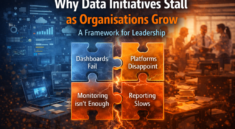
The question that derails most analytics projects
There is one question that quietly derails most analytics projects before they even begin. Sounds practical. Makes sense. Even professional.
“What data do we have?”
That question seemed like the right place to start. No. Because once you start with the data, you’ve given up control of the story.
The data-first trap
When you start with “What data do we have?”, you move straight into exploration.
You start asking:
- What tables are there?
- What measurements can we calculate?
- What details might be of interest?
- What visuals can we build?
And before long, you have a dashboard full of disconnected graphs.
- Technically everything is correct
- They are all individually interesting
- Nothing aligns with any particular decision
This is what makes dashboards an analytical playground and not a decision-making tool. Data becomes the starting point. And that decision became an afterthought.
Better question
The better question is simple:
“What decisions are currently blocked?”
That question changed everything. This immediately creates focus. This forces prioritization. It defines what is important, and just as important, what is not.
If the blocked decision is:
“Should we expand to the Northern Region?”
Then half your metrics are irrelevant. If the blocked decision is:
“Should we raise prices this quarter?”
Then the analysis narrows dramatically.
If the blocked decision is:
“Which customers are most at risk?”
Then you know exactly what signals need to appear. When you start with decision making, the report has a purpose. When you start with data, reports have options. Choices create adventure. Goals create clarity.
Why does this work right away
This is what makes it so practical. You don’t need any new tools. You don’t need a new platform. You don’t need any further skills. You just need a different starting point. Instead of asking your stakeholders:
“What do you want to see?”
Ask:
“What decision do you want to make?”
That single change prevented 80% of unnecessary dashboards from being created.
When decisions come first, data becomes a tool
Once the decision was clear, something important happened. Data is no longer the hero. It becomes a tool. You only include what helps move the decision forward. You exclude what is not. You stop building for completeness. You start to build clarity. That discipline makes reports smaller, sharper, and more impactful. Not because the problem is small. Because the coverage is intentional.
Identify your audience
There is another layer here that is just as important. Different audiences not only want different levels of detail. They want a different story.
Executives ask:
“Are we on the right track, and what needs to change?”
The manager asks:
“Where should I focus my attention?”
Analysts ask:
“Is this statistically valid, and what is driving it?”
The frontline team asks:
“What should I do differently tomorrow?”
If you try to answer all these questions in one report, you usually won’t answer any of them well. This is why audience clarity is so important.
Same data, different story
The key insight here is this: You don’t need different data sets for different audiences.
You need a different narrative. The underlying data can support multiple perspectives. However, the structure, emphasis and framing must be changed. An executive view might start with:
- target vs actual
- risk level
- clear recommendations
Managers’ views may focus on:
- team level damage
- root cause
- immediate action area
Analyst views may include:
- variance drivers
- distribution pattern
- confidence and anomaly
Same data. Different story. Different heroes.
The dangers of “one perfect dashboard”
There is a temptation in analytics to build the best dashboard, the one that answers everything. In reality, these dashboards typically become bloated, complicated, and cognitively burdensome. This makes for an impressive artifact. But not a useful one. Good data storytelling is not about creating one perfect report. It’s about creating the right reports for the right decision makers.
A simple framework that you can use straight away
Before starting your next analytics project, answer these three questions:
- What decisions are currently blocked?
- Who owns the decision?
- What would change if we had clarity?
If you can’t answer those questions clearly, stop. Don’t create a dashboard yet. Because if the decision is not clear then the report will also be unclear.
Why does this immediately improve analysis
This shift has an immediate impact. The report becomes:
- short
- more focused
- easier to navigate
- quicker to interpret
Meetings have changed too.
Instead:
“What does this mean?”
You hear:
“So we have to…?”
That’s the difference between reporting and decision support.
Want to create a report that puts decisions first?
If you want your Power BI reports to move from exploration to action, that’s what we focus on Data Accelerator.
We help teams initiate decision making, design narratives, and create reports that reduce uncertainty and accelerate results.
In the next post, we’ll learn how to measure decision making itself — and why “decision latency” may be the most important KPI you’re not tracking.
previous post: You Are the Guide: Power BI Reporting that Puts Decisions First
Related: The Hero’s Journey in Analytics: Why the Audience is the Hero
Start series: Dashboards Don’t Drive Decisions (And That’s the Real Problem with Analytics)
Berita Terkini
Berita Terbaru
Daftar Terbaru
News
Jasa Impor China
Berita Terbaru
Flash News
RuangJP
Pemilu
Berita Terkini
Prediksi Bola
Technology
Otomotif
Berita Terbaru
Teknologi
Berita terkini
Berita Pemilu
Berita Teknologi
Hiburan
master Slote
Berita Terkini
Pendidikan
Resep
Jasa Backlink
Slot gacor terpercaya
Anime Batch