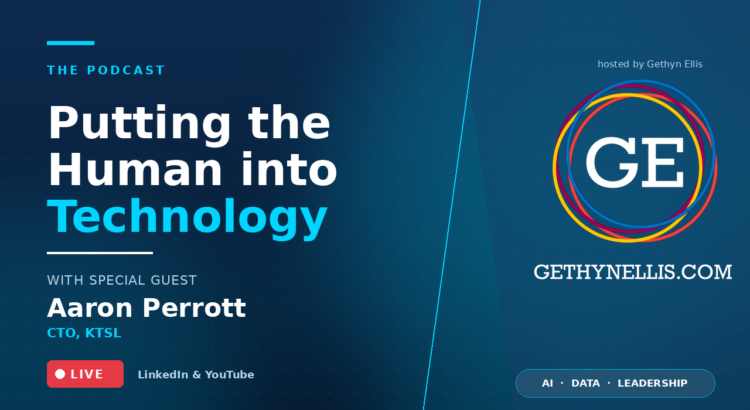
On the latest episode of Putting the Human into TechnologyI sat down with Aaron Perrott, Chief Technology Officer at KTSLfor a conversation about AI, data, IT Service Management, and how technology leaders can use both to make better decisions, reduce noise, and create more resilient systems.
Aaron brings more than 30 years in IT, having started on a service desk in the NHS before moving through development, databases, architecture, and design into executive leadership. Today, as CTO at KTSL, he works at the intersection of technology, operations, and business problems — helping organizations understand not just what technology can do, but what problem it should actually solve.
What we covered
- How KTSL has approached AI over time — from building models around service management and IT operations data more than a decade ago to now using tools like Copilot and Claude day to day across the business.
- Where AI is delivering practical value today — including faster analysis of ticket and event data, improved knowledge creation, better document and tender drafting, and using prompting to accelerate application development.
- Why training still matters — especially for non-technical teams, where unlocking value from AI often comes down to showing people how to use the tools properly within the flow of their work.
- How AI is shortening the path from data to action — helping organizations identify repeat incidents, isolate poor data quality, surface patterns faster, and build a clearer business case for automation and improvement.
- Chained AI and self-healing systems — where one AI process feeds another to pull logs, analyze errors, locate the right knowledge article, and in some cases trigger fixes automatically with the right guardrails in place.
- Leadership, dashboards, and decision-making — why reporting should increasingly be real time, how AI can suppress noise, and how leaders can get to better decisions faster by bringing together multiple data points in one place.
- DEX and user experience measurements — how analyzing user journeys inside applications can reveal friction points and even support rapid UI improvements based on real behavior.
- Will AI replace us? — Aaron’s view that it won’t, because human imagination, instinct, validation, judgment, and empathy still matter, even as AI changes the shape of entry-level and technical roles.
Why this conversation matters
If you lead technology, data, operations, or service delivery, this conversation is a useful reminder that AI value rarely comes from hype alone. It comes from applying it to real operational problems: reducing manual effort, improving the quality of decisions, identifying where processes are broken, and creating the space for people to focus on higher-value work.
Aaron shares a grounded perspective shaped by years of hands-on experience in service management and enterprise technology. He talks openly about the importance of guardrails, the limits of poor-quality data, and the reason humans still need to stay firmly in the loop — particularly when judgment, accessibility, behavior, and user context matter.
Whether you’re a CIO, IT Director, Head of Service, operations leader, or someone trying to work out where AI genuinely fits inside an organization, there is a lot in this discussion that will resonate.
Watch the full episode
Connect with Aaron
Never miss an episode
Putting the Human into Technology is the podcast for leaders who want to cut through the hype and focus on how technology and data actually deliver outcomes for people and organizations. Subscribe on YouTube and follow me on LinkedIn so you don’t miss the next conversation.
PakarPBN
A Private Blog Network (PBN) is a collection of websites that are controlled by a single individual or organization and used primarily to build backlinks to a “money site” in order to influence its ranking in search engines such as Google. The core idea behind a PBN is based on the importance of backlinks in Google’s ranking algorithm. Since Google views backlinks as signals of authority and trust, some website owners attempt to artificially create these signals through a controlled network of sites.
In a typical PBN setup, the owner acquires expired or aged domains that already have existing authority, backlinks, and history. These domains are rebuilt with new content and hosted separately, often using different IP addresses, hosting providers, themes, and ownership details to make them appear unrelated. Within the content published on these sites, links are strategically placed that point to the main website the owner wants to rank higher. By doing this, the owner attempts to pass link equity (also known as “link juice”) from the PBN sites to the target website.
The purpose of a PBN is to give the impression that the target website is naturally earning links from multiple independent sources. If done effectively, this can temporarily improve keyword rankings, increase organic visibility, and drive more traffic from search results.