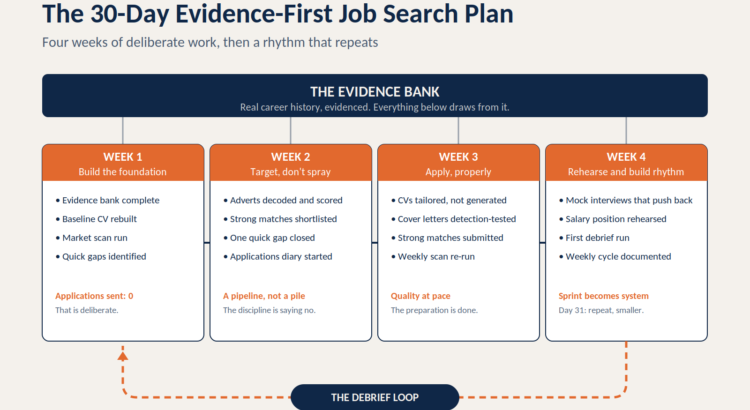
Everything in this series so far has been a component. This post is the assembly instructions.
Over the past two months I have walked through the state of the 2026 recruitment market, the evidence bank, decoding adverts, tailoring CVs, the cover letter detection test, and mock interviews that push back. Each works on its own. But the candidates who get results run them as a system, in sequence, on a schedule. That is what the 30-day plan is: the whole framework compressed into four weeks of deliberate work.
A word on what 30 days can and cannot do, because the whole series stands on honesty. Thirty days will not manufacture experience you do not have. What it will do is take the experience you do have and make sure it is captured, targeted, presented and rehearsed properly. For most candidates, that alone is the difference between drowning in a market averaging well over a hundred applications per vacancy and standing out in it.
Week 1: build the foundation
No applications this week. Even if it feels wrong, resist the urge.
The first week belongs to the evidence bank: the structured record of your real career history, with outcomes, numbers and context, that every later step draws from. If you skip this and go straight to applying, you will end up doing what everyone else does: pasting adverts into a chatbot and submitting whatever comes back. The state-of-play data showed exactly how that ends.
Your week 1 outputs:
- A complete evidence bank, built to the template in the whitepaper. Two or three focused sessions, not one marathon.
- A baseline CV rebuilt from the evidence bank, so every claim on it traces to something real.
- A market scan for your target role and region: the ten most demanded skills, typical salaries, and your gaps ranked by how quickly you could close them.
That last item shapes week 2. If the scan shows a gap you can close in a weekend, a lab, a write-up, a small project, close it now, and it goes straight into the evidence bank as fresh evidence.
Week 2: target, don’t spray
This week you build your shortlist, and the discipline is saying no.
Run the decode on every advert that interests you: real requirements separated from wish-list padding, red flags surfaced, your evidence scored against what is actually being asked. Then apply the rule from the decode post ruthlessly. Weak matches do not get applications; they get a gap plan or a pass. Middling matches get an application only if you can address the gap honestly. Strong matches are where your effort goes.
Your week 2 outputs:
- A decoded, scored shortlist of live roles, typically eight to twelve worth pursuing.
- One quick-close gap actually closed and evidenced.
- Your applications diary started: every role, its score, its deadline, its status. A spreadsheet is fine. The point is that your search now has a pipeline, not a pile.
By Friday of week 2 you will have sent precisely zero applications and be better positioned than most candidates a month into their search.
Week 3: apply, properly
Now the volume week, except volume here means quality at pace, because the preparation is done.
For each strong-match role: tailor the CV from the evidence bank against the decoded requirements, with the no-invention constraint in the prompt. Write the cover letter the same way, then put it through the detection test before it goes anywhere near a submit button. If it reads like a machine wrote it, it gets rewritten, because the first reader may be an algorithm but the reader who matters is a human with ninety seconds.
Your week 3 outputs:
- Applications submitted to every strong-match role on the shortlist, each one tailored, tested and logged.
- The diary updated: what went out, when, and what the advert asked for, because you will need that decode at interview.
- The weekly market scan re-run. New roles enter the pipeline at the decode stage, not the panic stage.
Expect this to be slower per application than the spray approach and faster in aggregate, because you are only doing the work on roles where it can pay off.
Week 4: rehearse, and build the rhythm
Interviews follow applications on a lag, so week 4 does two jobs: preparation for the conversations that are coming, and converting the sprint into a sustainable weekly cycle.
The mock interview work from the last post goes here: sessions built from the actual decoded requirements of the roles you applied for, with the model instructed to push back, probe your weakest evidence and refuse to accept waffle. Rehearse the salary conversation with real market data from your scans, not a number you hope sounds reasonable.
And run your first debrief. Every application outcome, every recruiter response, every silence is data. What got responses, what did not, which requirements you keep failing to evidence: it all feeds back into the evidence bank and the next week’s targeting.
Your week 4 outputs:
- At least two full mock interviews against real target roles, with the transcript reviewed for weak answers.
- A salary position, researched and rehearsed.
- The weekly rhythm documented: scan Monday, decode midweek, applications by Friday, debrief the lot.
Day 31 onwards
The plan does not end; it repeats, smaller. The evidence bank is built, so weeks 1 and 2 collapse into a standing Monday routine, and the search settles into a sustainable cycle you can run alongside a notice period or a current role without burning out.
The honest close, consistent with everything in this series: this plan makes the strongest version of your real candidacy visible to a market that is increasingly automated on both sides of the table. It does nothing else, and it does not need to. The candidate in the room finally matches the candidate on the page, and in 2026 that is rarer than it should be.
Get the complete framework
Everything in this plan, the evidence bank template, the full 15-prompt library, the pre-submission checklist and the 30-day plan itself as a printable schedule, is in my whitepaper, The Evidence-First Job Search. It is free to download.
Download The Evidence-First Job Search
PakarPBN
A Private Blog Network (PBN) is a collection of websites that are controlled by a single individual or organization and used primarily to build backlinks to a “money site” in order to influence its ranking in search engines such as Google. The core idea behind a PBN is based on the importance of backlinks in Google’s ranking algorithm. Since Google views backlinks as signals of authority and trust, some website owners attempt to artificially create these signals through a controlled network of sites.
In a typical PBN setup, the owner acquires expired or aged domains that already have existing authority, backlinks, and history. These domains are rebuilt with new content and hosted separately, often using different IP addresses, hosting providers, themes, and ownership details to make them appear unrelated. Within the content published on these sites, links are strategically placed that point to the main website the owner wants to rank higher. By doing this, the owner attempts to pass link equity (also known as “link juice”) from the PBN sites to the target website.
The purpose of a PBN is to give the impression that the target website is naturally earning links from multiple independent sources. If done effectively, this can temporarily improve keyword rankings, increase organic visibility, and drive more traffic from search results.