The worst CV I’ve seen this year was beautifully written. Clean structure, confident language, not a comma out of place. It was also completely void, empty of character and personality. Every line could have described a thousand other people, because an AI wrote it from a job advert and a prayer, and the candidate had given it nothing of themselves to work with.
If you’re using AI to write your CV, you’re in good company. Greenhouse’s research puts AI use among US job seekers at 74 per cent, and UK surveys show around half of candidates using it on their CVs. But most people are doing it backwards. They start with the document, when they should start with the evidence.
The blank page is not your problem
AI has not made CVs easier to write. It has made empty CVs easier to write. UK graduate roles now attract around 140 applications each, according to Institute of Student Employers data, and the one large applicant-tracking dataset that measures it puts application-to-interview conversion at roughly 3 per cent. Recruiters describe the pile the same way every time: walls of interchangeable, obviously generated applications that cluster together and sink together.
The instinct is to blame the tool, or to hunt for a cleverer prompt. Neither are really the problem. Generic output is what happens when there is nothing distinctive going in. The model cannot know that you rescued a migration nobody else could, or trained the team that took over support, or held a deadline together with sheer stubbornness in a regulated environment. Only you know that. If it is not written down anywhere, the AI will fill the gap with confident fiction or polished padding.
What an evidence bank is
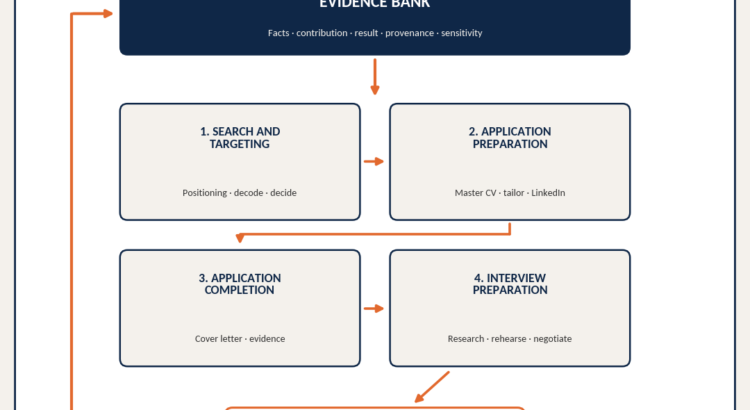
An evidence bank is a structured, reusable record of your actual career: every role, project and result you can substantiate, captured with the situation, what you specifically did, the skills demonstrated and the strongest supportable outcome. It becomes the single source of truth for everything AI produces on your behalf.
In twenty years of consulting, I have watched the same rule decide whether AI projects deliver or merely demo well: quality of input, clarity of structure, human ownership of output. Your job search is no different. The evidence bank is the quality input. Build it before you touch a single job advert.
How to build one in an evening
Start with a brain-dump. Open a blank document and empty your career into it: every role, every project, every result you can stand behind, every awkward problem you solved, every time you saved money, rescued a deadline or fixed something nobody else could. Do not polish it. Do not order it. Get it down with dates, scope, constraints, technologies and outcomes.
Then hand the mess to your AI assistant with a prompt along these lines:
You are a career analyst. Here is an unstructured brain-dump of my career history. Restructure it into an evidence bank: for each item, extract the situation, what I specifically did, the skills demonstrated, and the strongest substantiated result. Separate facts I have supplied from inferences you make. Do not turn an approximate result into a precise number. Flag vague results and ask me questions to sharpen them. Do not invent anything.
The questions it asks back are where the value lives. ‘You said you improved the reporting process: by how much? For how many users? What was it costing before?’ Answer honestly, from memory, old appraisals and project documents. Most people discover their career is considerably stronger than their CV has ever suggested.
Evidence does not only mean numbers
One word of caution, because this trips people into dishonesty. Insisting that every achievement carries a percentage pressures candidates into false quantification, and it undervalues careers in care, education, the public sector and support functions where the results are real but rarely expressible as revenue. Good evidence comes in four classes: quantified outcomes you can stand behind, observable changes (a process that stopped failing, a backlog cleared), third-party validation (awards, appraisal language, being asked back), and credible scope (the team size, budget or regulatory pressure you carried). A safeguarding improvement delivered across a difficult stakeholder landscape is stronger evidence than a tidy but unverifiable 30 per cent.
Why this beats a better prompt
Once the bank exists, the AI’s job changes from invention to arrangement, and everything downstream improves. Your CV becomes a tailoring exercise: reorder and reweight true material for each role, rather than generating prose from nothing. Cover letters draw on specific, defensible achievements. Interview preparation becomes rehearsal of things that actually happened. And you can defend every line under questioning, which matters, because employers penalise the appearance of low effort far more than they penalise AI use itself. In Insight Global’s survey of just over a thousand US hiring managers, what triggered suspicion was not the tool but the signal that the candidate had not bothered.
There is a quieter benefit too. The bank compounds. Add an entry after every significant project and every interview debrief, and next year’s job search starts from a warm engine instead of a blank page. Most candidates start from zero every time. You will not.
The takeaway is simple. Do not ask AI to make you sound impressive. Ask it to help you organise the ways you already are, and make sure it has the raw material to work with. The evidence comes first. The CV is just the view.
Get the Evidence Bank workbook
I’ve packaged this method into a free implementation kit: the full Evidence-First whitepaper, an editable Evidence Bank workbook in Word and Excel, a five-factor application decision sheet, a 30-day plan and the complete 15-prompt library. Download the free Evidence-First kit and you can have a working evidence bank by the weekend.
Useful Links
How to Use AI in Your Job Search | Gethyn Ellis
PakarPBN
A Private Blog Network (PBN) is a collection of websites that are controlled by a single individual or organization and used primarily to build backlinks to a “money site” in order to influence its ranking in search engines such as Google. The core idea behind a PBN is based on the importance of backlinks in Google’s ranking algorithm. Since Google views backlinks as signals of authority and trust, some website owners attempt to artificially create these signals through a controlled network of sites.
In a typical PBN setup, the owner acquires expired or aged domains that already have existing authority, backlinks, and history. These domains are rebuilt with new content and hosted separately, often using different IP addresses, hosting providers, themes, and ownership details to make them appear unrelated. Within the content published on these sites, links are strategically placed that point to the main website the owner wants to rank higher. By doing this, the owner attempts to pass link equity (also known as “link juice”) from the PBN sites to the target website.
The purpose of a PBN is to give the impression that the target website is naturally earning links from multiple independent sources. If done effectively, this can temporarily improve keyword rankings, increase organic visibility, and drive more traffic from search results.