I’ve started saying the word ‘skills’ a lot, in posts, client conversations, and on AI operating system consulting pages. It does a lot of work in those sentences, and when I looked for a simple explanation in English to direct people, I couldn’t find it. The answer could be developer documentation or vendor explanation. So here’s the version I give clients.
Claude’s Skills are folders of instructions that teach Claude, Anthropic’s AI assistant, how to perform certain tasks according to your wishes. The bottom line is a file called SKILL.md that contains a brief description of when the skill is applied and detailed instructions on how to do the job: your template, your rules, your quality standards. Claude read it automatically every time a task came up.
The mechanics, in a nutshell
You don’t need to be technical to follow this, and that’s the point. Skills are folders. Inside is the one required file, SKILL.md, written in simple language with little structure at the top: a name, and a description that tells Claude when the skill should be used. Underneath are the instructions, written like you would brief a qualified new starter. The folder can also hold supporting files, such as reference documents, templates, or scripts, that Claude only reads when needed.
What makes this smarter than it sounds is that skills are loaded dynamically. Claude looks at a brief description of each skill you have installed, and provides complete instructions only when there is a suitable task. Request a proposal and the proposal skill is activated; asked about the spreadsheet and it wasn’t annoying. You don’t put everything into one big command. You’re building a library, and the right volume appears at the right time.
Skills work across Anthropic products: Claude apps, Claude Code for developers, and APIs for anything you build yourself. Anthropic has also published the format as an open standard, which is important if you’re nervous about locking your company’s knowledge into a single vendor’s file format. Details are in the Anthropic Agent Skills documentation if you want technical depth.
A command is typed. A skill is possessed.
This is the distinction that I find most difficult for business owners. A prompt is something someone types into a chat box and it disappears. It lives in a person’s head, changes according to his mood, and just disappears. Skills are files owned by the company. It can be versioned, reviewed, refined, and handed off to every member of the team, and from the day it is improved, everyone’s output increases with it.
Here’s what it looks like in practice. My proposal skills don’t say ‘write a good proposal’. It encodes my discovery questions, my part order, my pricing logic, and phrases I don’t want near client documents. As I refine how I handle price objections, those refinements are entered into a file once. Every proposal after that included it. Twenty years of methods, combined in a text file rather than shrunk down in my head.
What skills are not
A skill is not a plugin or application; there’s nothing to install in a software sense, and nothing to be approved by your IT team other than Claude himself. This is not refining or training the model, which is an expensive machine learning exercise that most companies will not need. And it’s not magic. A skill is only as good as the method written in it, which is why the hardest part of building it isn’t the files. This means taking a company’s actual working methods out of the minds that hold them and onto the page.
Why this matters is beyond technology
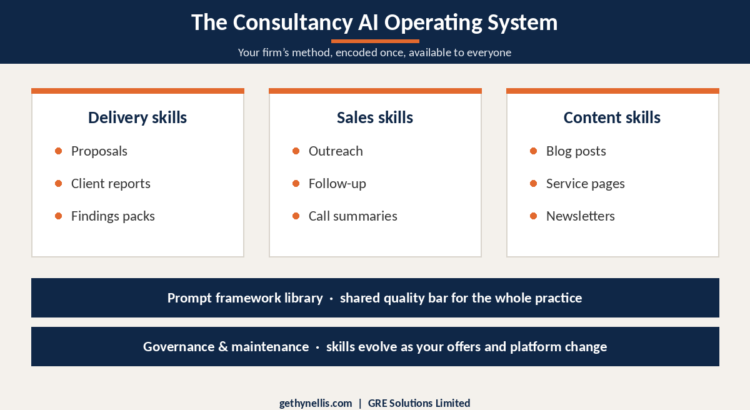
I run my consultancy on the following libraries: proposals, client reports, blog posts, SEO pages, SQL Server health check reports. Individually, each one saves time. Collectively, they’re something more interesting: the first practical mechanism I’ve ever seen for a small company to own its methods as an asset rather than rent them from whoever happens to be in the building. That collective library is what I call a consulting AI operating system, and I’ve written a complete explanation of that operating system model separately.
A frank warning: skill file formats belong to the AI world and will continue to evolve. Your company’s coding method does not. If written correctly, it can port between platforms, survive vendor churn, and improve with use. That is his asset. The file is in place this year.
See skills in action at real companies
If you want to see what the skills library looks like when running real consulting, the consulting AI operating system page includes a complete model, with published pricing and a 30-minute working demo where I run my own company on screen.
Frequently asked questions
Do I need to be a developer to make Claude skills?
No. Skills are written in simple language, structured like you are briefing a skilled new beginner. The technical wrapper is minimal: one folder, one Markdown file, and a brief description at the top. The hard part is clearly articulating your method, not the file format.
What is the difference between Claude’s skills and custom GPT?
They solve similar problems in different ecosystems. Custom GPT is configured inside ChatGPT; skills is a portable folder of instructions that works across Claude applications, Claude Code, and APIs, and follows published open standards, so coded methods are easier to port and version.
Where Does Claude’s Skill Work?
Across Anthropic products: Claude apps on paid plans, Claude Code, and Claude API. Because Anthropic has published the format as an open standard, other tools that adopt it can perform the same skills, although support varies by platform.
Can a skill contain confidential business information?
Skills typically encode the template, tone, and logic of your commercial, so treat the file as carefully as any business document. Store them in your own storage, control who can edit them, and only install skills from sources you trust, because skills drive AI behavior.
PakarPBN
A Private Blog Network (PBN) is a collection of websites that are controlled by a single individual or organization and used primarily to build backlinks to a “money site” in order to influence its ranking in search engines such as Google. The core idea behind a PBN is based on the importance of backlinks in Google’s ranking algorithm. Since Google views backlinks as signals of authority and trust, some website owners attempt to artificially create these signals through a controlled network of sites.
In a typical PBN setup, the owner acquires expired or aged domains that already have existing authority, backlinks, and history. These domains are rebuilt with new content and hosted separately, often using different IP addresses, hosting providers, themes, and ownership details to make them appear unrelated. Within the content published on these sites, links are strategically placed that point to the main website the owner wants to rank higher. By doing this, the owner attempts to pass link equity (also known as “link juice”) from the PBN sites to the target website.
The purpose of a PBN is to give the impression that the target website is naturally earning links from multiple independent sources. If done effectively, this can temporarily improve keyword rankings, increase organic visibility, and drive more traffic from search results.