I’ve been meaning to write an update about Last Person Standing – a web app I created for the game of the same name, for some time. With four teams remaining in the 2026 World Cup and the semifinals ahead of us, now feels like the right moment. In fact, this tournament moves so fast between rounds, the gap between the quarterfinals at the weekend and the start of the semifinals tomorrow, this is my only chance to write about it.
From side projects to World Cup week
I built the framework of the platform in March, ran it quietly through the end of the Premier League season with a few test games, and then moved on to preparing for the World Cup. The week before the tournament started, I was in Brussels to deliver a series of Power BI training for a large institution that shall remain nameless, so my evenings that week were spent at the hotel refining features and fixing bugs before the big tournament started.
It paid off. The growth we saw that week was incredible; we ranked number one on Google for some variation of “Last Man Standing World Cup 2026” and got a huge amount of traffic and, more importantly, a lot of truly engaged users. We had over 670 people register in the two weeks before the start of the World Cup.

But the thing I’m most proud of: this platform was built to help grassroots football clubs raise money, and I know of at least two local clubs in Wolverhampton who have used it to raise decent sums for their clubs this summer. That’s always been the point.
The numbers
By the time the group stage begins, we have:
- 670+ registered players
- 123 competitions prepared for the World Cup
- About 30% the competition becomes what I call a legitimate competition – my line in the sand is three or more players
- The biggest competition takes place 61 participantswith a long tail into the fifties, thirties, and twenties
For the remainder of this post, I want to focus on the competition that reached double digits, ten or more participants. Fifteen competitions met those standards, and after six rounds were completed, ten of them are still alivewith a winner yet to be determined to advance to the semifinals.
That’s what you want from the Last Person Standing format: most games survive deep into the tournament, still alive in the final rounds of play.
Game state
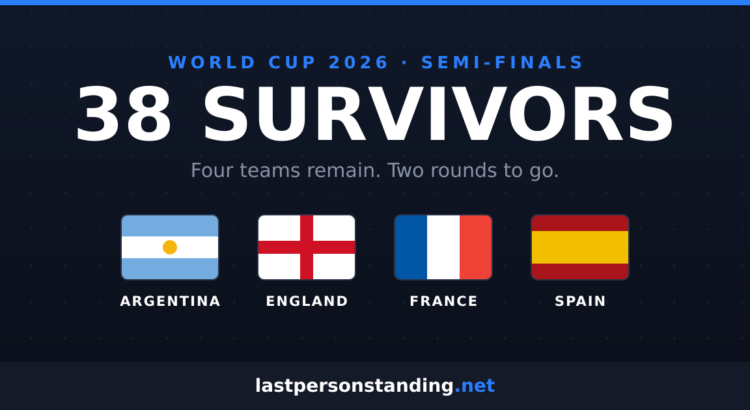
The following is the situation in the World Cup survivor competition: 38 players are still standingand only four teams remain in the tournament – Argentina, England, France and Spain.
If you’ve never played, the rules are very simple: pick one team per round, and if they win, you stay. Lose or draw and you’re out. The catch that makes it a strategy game and not a tipping contest: You can’t pick the same team twice.
Six rounds in, the rule applies. Each survivor has burned down six teams, and only four are left to choose from. Following are the details of the remaining 38 survivors in the tank:
| Teams they can still choose | Player |
|---|---|
| All 4 left | 2 |
| 3 of 4 | 4 |
| 2 of 4 | 12 |
| 1 of 4 | 13 |
| 0 (already used all four) | 7 |
(A quick note about the last row: “used” includes picks already locked in for the current round, the semi-finals, so the seven players with zeros have either given up their semi-final picks or completely exhausted all four at the start of the tournament.) In this case they would be eliminated after the semi-finals
The strategy is pressure
The table is the whole game in miniature.
Two players can still choose all four The semifinalists played the group stage perfectly — they lasted six rounds without touching a single big gun. They were now free to choose the strongest remaining team, just when it mattered most.
That thirteen players make up one team is in the opposite position. Their tournament now hinges entirely on one side they might have been forced to play just a few weeks ago. If the team is playing in the semifinals against a stronger opponent, they can’t do anything — no pivot, no hedge. That’s the price of spending your Spain and France on a group stage banker.
It’s a classic Last Person Standing dilemma: the “safe” pick at the start of the tournament is borrowed from your future self, and that loan matures in the semifinals.
What’s left to play
Two semi-finals in the middle of the week, and then the final and third place match at the weekend. Here’s a format quirk you need to know: on the platform, The match for third place shared the final round with the Final itself. So if you make it to the semifinals, you have four possible teams to choose from in the final round instead of two, including the losing semifinalist team. For players who have used both finalists, a third-place match may be the only path to the title.
And if more than one player survives the final whistle on July 19? Then the pots are distributed, or placed according to the organizer’s wishes. With 38 players, four teams and two rounds remaining, some of our competitions are heading towards a tense finish.
Set up your own Last Man Standing competition
The World Cup has been a shining proving ground, but Last Person Standing is built for the long term, and the 2026/27 Premier League season is just around the corner.
If you run a grassroots club, a Sunday league team, an office draw or just a group chat all about football, you can organize your own competition in minutes, free to get creative. You handle entry fees and fundraising according to your club; The platform never touches money, so every penny collected stays where it belongs — with you. Now it’s time to register
Thirty-eight players start the week with the hope of being the last one standing. Next season, one of them could be from your club. The game will return to the Premier League when the World Cup ends
PakarPBN
A Private Blog Network (PBN) is a collection of websites that are controlled by a single individual or organization and used primarily to build backlinks to a “money site” in order to influence its ranking in search engines such as Google. The core idea behind a PBN is based on the importance of backlinks in Google’s ranking algorithm. Since Google views backlinks as signals of authority and trust, some website owners attempt to artificially create these signals through a controlled network of sites.
In a typical PBN setup, the owner acquires expired or aged domains that already have existing authority, backlinks, and history. These domains are rebuilt with new content and hosted separately, often using different IP addresses, hosting providers, themes, and ownership details to make them appear unrelated. Within the content published on these sites, links are strategically placed that point to the main website the owner wants to rank higher. By doing this, the owner attempts to pass link equity (also known as “link juice”) from the PBN sites to the target website.
The purpose of a PBN is to give the impression that the target website is naturally earning links from multiple independent sources. If done effectively, this can temporarily improve keyword rankings, increase organic visibility, and drive more traffic from search results.