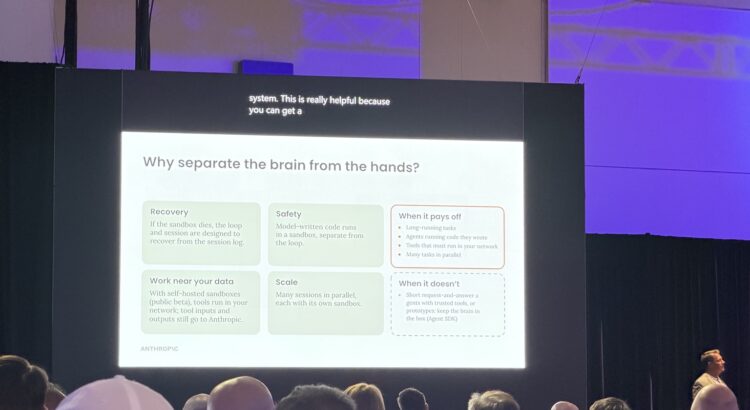
The most interesting thing I took from Anthropic’s session at Microsoft Ignite 2026 this week wasn’t a new model. It was a decision about AI agent architecture that could make agents considerably more practical in enterprise environments: separating the brain from the hands.
It’s a simple idea. It also changes how you build, secure and operate agents once they leave the demo and start doing real work.
First, what is an AI agent?
Anthropic offered a refreshingly plain definition:
An agent is a model using tools in a loop.
The model receives a task, decides what needs doing, calls a tool, examines the result and decides what to do next. That loop repeats until the task is complete.
Ask an agent to analyse a month’s sales performance and it might retrieve the data, write some Python to analyse the numbers, spot unusual trends, generate a chart and produce a summary. Each action informs the next. The agent isn’t just generating an answer. It’s doing work.
Which raises the architectural question: should the system making the decisions also be the system executing the work? Anthropic’s argument is that, for certain classes of agent, the answer is no.
The brain decides. The hands do the work.
Think of an agent as two distinct parts.
The brain handles reasoning, planning and context. It runs the agent’s loop, interprets results and decides whether the task is finished.
The hands execute actions. They run Python, process files, execute commands and interact with systems and services.
Many agent implementations combine both in the same execution environment. In the design Anthropic demonstrated, the brain keeps managing the task while the hands operate inside a separate sandbox, an isolated environment built to execute code and tools. The model decides what code needs writing, but that code never runs alongside the orchestration logic.
Four reasons this AI agent architecture matters
1. Safety
If an agent writes code to solve a problem, that code has to run somewhere. Running it in a separate sandbox adds a security boundary between model-generated code and the system managing the agent itself.
Sandboxing is not a complete security strategy. Permissions, network access, credentials and data handling still need proper thought. But it is a much better starting point.
2. Recovery
What happens when an agent has been working for twenty minutes and its execution environment crashes? In a tightly coupled design, usually nothing good.
Anthropic described an architecture where the agent’s loop and session can recover from the session log, even when the sandbox fails. For agents doing substantial jobs, that is the difference between a blip and starting the whole task again.
3. Scale
Separation makes parallel execution practical. You can run multiple agent sessions at once, each with its own sandbox.
Think hundreds of customer documents, several datasets or a batch of independent research tasks. Instead of forcing everything through one environment, the work is spread across isolated ones and scaled independently.
4. Working closer to your data
This was the one that caught my attention from an enterprise perspective. Anthropic discussed self-hosted sandboxes, in public beta at the time of the session, where tools execute inside your own network. That opens the door to agents working with internal applications, private data sources and enterprise infrastructure.
There is an important qualification. Anthropic’s slides stated explicitly that tool inputs and outputs still go to Anthropic in this configuration.
Running tools inside your network does not mean all the data stays inside your network. IT leaders need to understand that distinction before making any security, governance or compliance decision on the back of it.
Does every agent need this?
No, and I thought this was one of the more useful parts of the session.
For short request-and-answer interactions, agents calling trusted tools, or early prototypes, keeping everything together using the Agent SDK is perfectly sensible.
The separation earns its keep when agents are:
- running for extended periods
- executing code they have written themselves
- using tools inside private networks
- performing many tasks in parallel
Architecture should follow the workload, not the hype.
What this means for your business
We spend a lot of time debating which model an organisation should use. Model choice matters. But as businesses move from experimenting with agents to running them in production, the surrounding architecture matters just as much.
These are the questions I’d put to any agent project before it goes live:
- Where does the code execute?
- What happens when something fails?
- Which systems can the agent reach?
- Where does the data travel?
- Can we recover a task without starting again?
None of them are glamorous. All of them decide whether an agent is fit for real business use, and the brain-and-hands distinction gives you a practical way to work through them.
One to watch: where Claude actually runs
The slides also drew a distinction between Claude hosted by Anthropic and offered through Microsoft Foundry, and Claude hosted on Azure infrastructure. Even in the Azure-hosted configuration, the service is still operated by Anthropic and is not deployed inside your own Azure tenant.
If you are evaluating Claude alongside Microsoft Foundry and Copilot Studio, that has real implications for execution boundaries and data residency. I’ll cover it properly in a follow-up post.
The takeaway
The conversation in agentic AI is moving on from what the model can think about, towards how we safely and reliably let it do things. That is the point at which agents start earning their place in a business.
Put this into practice
If you want to move your team from experimenting with AI to using it properly at work, I’m running half-day Copilot workshops on 14 and 15 December. They are practical, hands-on and built around real business use. Book your place on the December Copilot workshops.
PakarPBN
A Private Blog Network (PBN) is a collection of websites that are controlled by a single individual or organization and used primarily to build backlinks to a “money site” in order to influence its ranking in search engines such as Google. The core idea behind a PBN is based on the importance of backlinks in Google’s ranking algorithm. Since Google views backlinks as signals of authority and trust, some website owners attempt to artificially create these signals through a controlled network of sites.
In a typical PBN setup, the owner acquires expired or aged domains that already have existing authority, backlinks, and history. These domains are rebuilt with new content and hosted separately, often using different IP addresses, hosting providers, themes, and ownership details to make them appear unrelated. Within the content published on these sites, links are strategically placed that point to the main website the owner wants to rank higher. By doing this, the owner attempts to pass link equity (also known as “link juice”) from the PBN sites to the target website.
The purpose of a PBN is to give the impression that the target website is naturally earning links from multiple independent sources. If done effectively, this can temporarily improve keyword rankings, increase organic visibility, and drive more traffic from search results.