A subtle mistake that most dashboards make
There are subtle errors that quietly exist in most analytical work.
- This is not a modeling problem
- This is not a visual design issue
- It’s not even a data quality issue
It’s a matter of identity. Most analytics are created as if data is the hero. And that’s the problem.
The data-centric trap
If you’ve worked in analytics for any length of time, you’ve definitely seen this pattern. The dashboard is presented with quiet pride:
“Look at the data.”
- Some charts
- Complex relationship
- Search page
- Impressive DAX action.
Technically very good. Structurally solid. But something didn’t land. The executive leaned forward and asked:
“So what does this mean?”
The manager asks:
“What should we do?”
The space becomes interpretive rather than prescriptive. Not because the data is wrong. Because the report was created as a showcase, not as a guide.
The Hero’s Journey (Business Edition)
In classical storytelling, every narrative has a hero.
- Heroes face uncertainty
- Heroes face obstacles
- Heroes need clarity
And on the way, the hero meets a guide. In business analysis, we often cast the wrong characters in the main roles.
We treat:
- Data sets as heroes
- Dash as a hero
- Analyst as hero
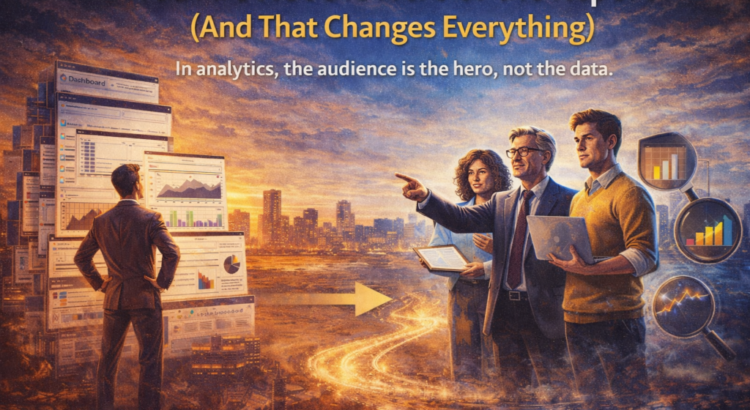
But none of them are heroes. The audience is the hero in analytics.
- Executive decision making strategies.
- Managers reallocate budgets.
- The team chooses priorities.
They are on the verge of uncertainty. And they are looking for clarity.
When data becomes the hero
When data is positioned as the hero, the focus shifts subtly:
- We emphasize completeness over clarity
- We show sophistication over simplicity
- We show what the model can do
The dashboard becomes a show. While this may impress a technically minded audience, it rarely speeds up decision making. Because the audience is left to translate the complexity into action themselves. And that’s not their job.
Story-centered analysis
Now flip the perspective. In a story-centric approach, the data is still there. It still matters. But it plays a supporting role. Heroes are decision makers. This report is here to guide them from:
Uncertainty → Understanding → Action
Instead of asking:
“What can we show?”
You asked:
“What does the hero need to know?”
Guides vs heroes: great stories that teach us
Think about some of the most familiar stories in modern culture.
In the Toy StoryWoody isn’t an overpowered hero, he’s a guide who helps Buzz Lightyear understand who he really is and how to navigate Andy’s world. Buzz may be the expert, but Woody provides the foundation.
In the Destroy Ralphone of my favorite films. Ralph believes he needs a medal to be a hero, but it is characters like Vanellope who guide him toward the understanding that identity is not determined by a person. scoreboard dashboard.
In the Harry PotterHarry is clearly the hero, but without Dumbledore, Hagrid, and even Hermione to guide him, he would never have survived the journey. The story works because the guide clears up confusion and lights the way. “Happiness can be found, even in the darkest of times, if one remembers to turn on the light.”
In the The Lord of the RingsFrodo carries the burden, but Gandalf and later Sam act as guides. They didn’t take the ring. They help the hero survive the journey.
In any case, this guide is not intended to showcase power or complexity. Guides exist to help heroes succeed. That’s your role in analytics.
The executive is Frodo.
The manager is Harry.
The team is Ralph.
You are Gandalf. You must not pass! How cool are you?
You are the guide
Once you accept that the audience is the hero, your role becomes clear. You are the guide. The guide doesn’t show off. The guide is not burdensome. Guide to removing obstacles. Guide reduces confusion. Your job is not to demonstrate technical skills. Your job is to help someone succeed in making decisions.
Guide what to actually do
Good guide:
- Anticipate questions before they are asked
- Removed unnecessary paths
- Signal risks clearly
- Points to the correct route
Applied to analytics, this means:
- Answer obvious objections beforehand
- Highlight the most important things
- Don’t emphasize what isn’t
- Organize information intentionally
This also means having an analytical opinion. It’s more important than that. This pattern is meaningful. This metric is noise.
Why great analysis feels simple
There’s a reason why the best reports often feel calm and straightforward. This is not because the underlying problem is simple. The reason is, there are those who think hard before the report is made.
- They clarified the decision
- They identify important signals
- They construct the narrative
- They eliminate the distraction
So the audience doesn’t have to.
The ego trap in analytics
Analysis is a technical discipline. It rewards sophistication. And this can create subtle ego traps. If you spend hours creating a model, it’s tempting to show everything. But the audience doesn’t feel proud of your model. They experience uncertainty about their decisions. The transition from hero to mentor requires humility.
A simple test
Go to one of your dashboards and ask:
- Who is the hero here?
- Does the report show the data?
- Or does it guide someone toward action?
If you feel it helps someone move forward, you have made a change.
Ready to become a guide?
If you want your Power BI reports to move from displaying data to guiding decisions, that’s what we focus on Data Accelerator.
We help teams move from reporting to decision support — building analysis based on clarity, confidence, and action.
In the next post, we’ll get practical and see how to start with the real questions — the decisions that are currently blocked — and build everything around them.
Related: Power BI Report Structure: Beginning, Middle, End
Start series: Dashboards Don’t Drive Decisions (And That’s the Real Problem with Analytics)
Berita Terkini
Berita Terbaru
Daftar Terbaru
News
Jasa Impor China
Berita Terbaru
Flash News
RuangJP
Pemilu
Berita Terkini
Prediksi Bola
Technology
Otomotif
Berita Terbaru
Teknologi
Berita terkini
Berita Pemilu
Berita Teknologi
Hiburan
master Slote
Berita Terkini
Pendidikan
Resep
Jasa Backlink
Slot gacor terpercaya
Anime Batch