The true test of an AI enablement program is not the certificate. That’s what changed on Monday.
Most corporate AI training results in two things: a feeling of momentum and a folder of certificates of completion. Nothing appears on the balance sheet. I’ve been to enough vendor-led sessions to know the pattern. Everyone went home excited, no one changed how it worked, and six weeks later the license paid for the tool, no one had opened it.
So when something different happens, it’s a good idea to write it down.
This week, mid (Week 8 of 12) an AI empowerment program I ran for the IT function of a large organization, one of the delegates told the room that the work driven by this program had led his team to automate processes they had done by hand for years. The estimated savings alone are about $400,000.
I’ll be honest about what those numbers are and what they aren’t. These are delegates’ own numbers, shared mid-air, not line items signed off by audited financials. I wanted to get the details right before taking it as gospel. But even with those caveats, these certificates tell you something that certificates never do: there’s an actual process change, and the change is big enough that the person in charge just assigned a number to the process.
Why is this the exception, not the rule
The unfortunate truth about AI skill enhancement is that most AI teaches tools, not results. People learn what Copilot can do, or how to build a pipeline in Power Automate, then return to a backlog that doesn’t give them the time or mandate to implement it. His knowledge evaporated. It’s not the people’s failure. This is a design failure.
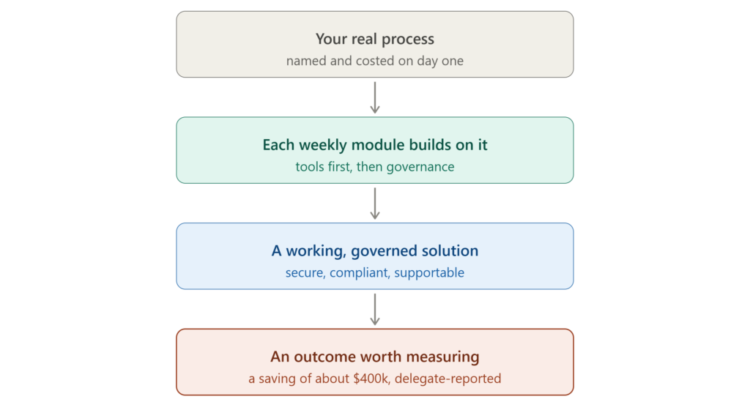
The thing that makes the difference here isn’t the demo being smarter. This means that each session is linked to real work that the delegates already have. Nobody makes a toy app to do exercises. They present a genuine, painful, repeatable process of their actual work, and this program exists to advance those specifics, week after week.
When you structure empowerment like that, learning will achieve its goals. $400,000 does not come from training in the abstract. That comes from someone who already understands the process well enough to know how much it will cost, finally being given the tools and permission to fix it.
What “anchoring in real work” really means in practice
It’s easy to say that training should be practical. Most providers say so. Far fewer have built them in such a way that they can survive contact with busy delegates. Here’s what I found makes a difference.
One real issue per person, mentioned on day one. Not a hypothesis. Specific processes, specific beneficiaries, and ideally a number attached to the current costs incurred in the form of time and money. If a delegate cannot mention these three things, then the rest of the program has nothing to use as a reference.
Each module advances that problem. Each session is not a stand-alone topic. This is another layer added to what delegates are actually building. In the end, they don’t have a certificate. They have a successful and organized solution that they can support.
Governance has existed from the start, not been implemented directly. Automation that deals with real business data must be secure, compliant, and supportable, or it will be turned off the moment someone in IT security notices it. Building that thinking early on is the difference between a clever proof of concept and something that sticks.
Skepticism still exists
This doesn’t mean that AI will change every organization overnight. I remain as skeptical of far-fetched claims as ever. Most AI initiatives remain under-delivered, and under-delivered for boring structural reasons: no clear problem, no ownership, no follow-up, no governance.
That’s why one real result is worth more than a hundred brilliant case studies. This is proof that when you fix a structural problem, technology will do the rest. These tools are truly capable now. The bottleneck has moved. That’s not AI. The issue is whether your people are equipped and allowed to demonstrate something important.
In conclusion
If you conduct AI training and the measure of success is attendance or satisfaction scores, you are measuring the wrong thing. Ask harder questions. Six weeks after the program ended, what changes were made, and what were the benefits? If the service provider can’t tell you how the training is designed to produce those answers, the service provider likely won’t provide those answers.
One delegation, one process, one number. That’s what good empowerment looks like.
Work with me on this
I design and deliver AI enablement programs that build on your people’s real work, not generic demos, so the learning results in something you can actually use. If that’s the kind of outcome you want for your team, see how an AI enablement program is structured, or contact us and we’ll discuss what one might look like for you.
PakarPBN
A Private Blog Network (PBN) is a collection of websites that are controlled by a single individual or organization and used primarily to build backlinks to a “money site” in order to influence its ranking in search engines such as Google. The core idea behind a PBN is based on the importance of backlinks in Google’s ranking algorithm. Since Google views backlinks as signals of authority and trust, some website owners attempt to artificially create these signals through a controlled network of sites.
In a typical PBN setup, the owner acquires expired or aged domains that already have existing authority, backlinks, and history. These domains are rebuilt with new content and hosted separately, often using different IP addresses, hosting providers, themes, and ownership details to make them appear unrelated. Within the content published on these sites, links are strategically placed that point to the main website the owner wants to rank higher. By doing this, the owner attempts to pass link equity (also known as “link juice”) from the PBN sites to the target website.
The purpose of a PBN is to give the impression that the target website is naturally earning links from multiple independent sources. If done effectively, this can temporarily improve keyword rankings, increase organic visibility, and drive more traffic from search results.